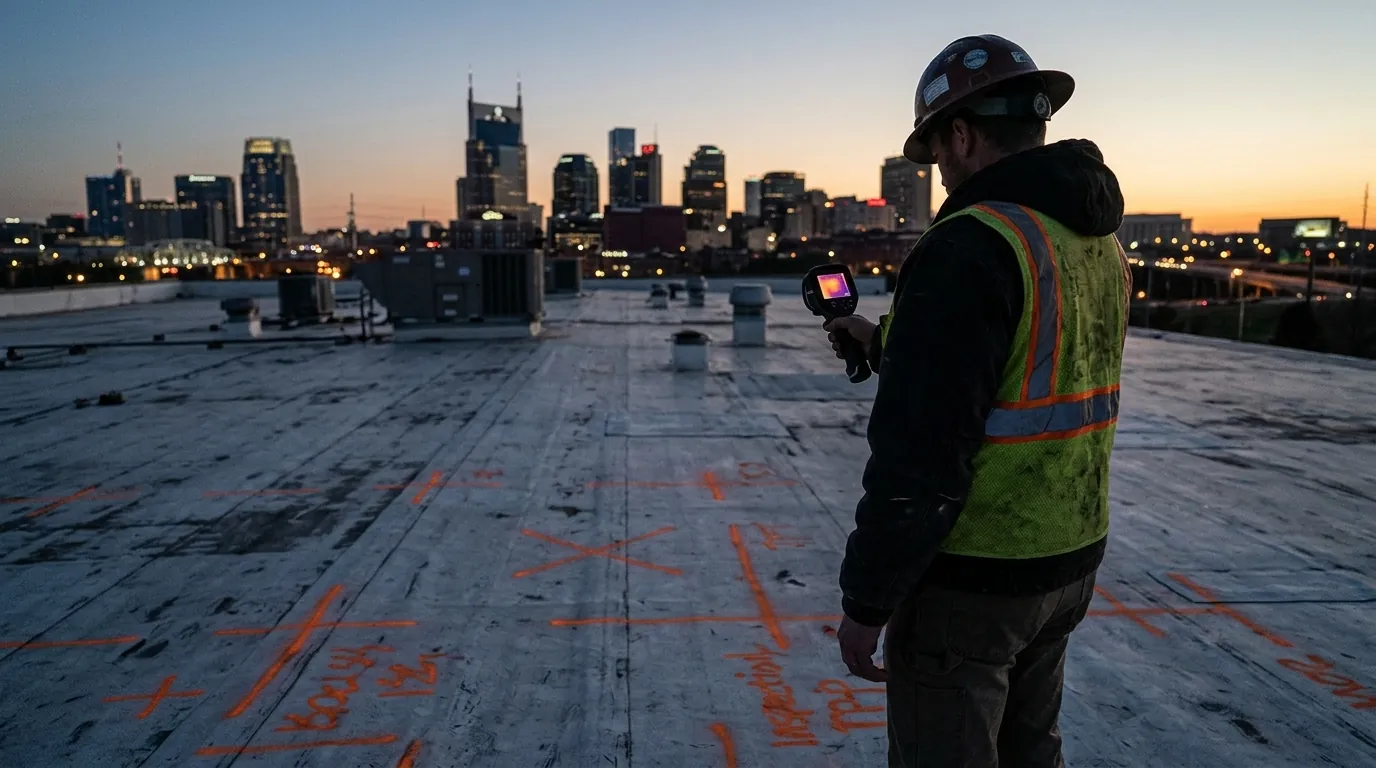
What the camera is really measuring
An infrared camera does not see water. It sees surface temperature. Wet insulation holds heat longer than dry insulation, so after a sunny day, wet areas stay warmer into the evening while dry areas cool down. The camera records those differences as a color map that an operator then interprets. Different roofing materials radiate heat differently, which complicates the picture.
That is useful, but it is inference. A warm patch might be wet insulation. It might also be a different insulation thickness, a roof drain, a patch of dark material, debris or a thermal bridge from a structural member. The scan gives you candidates, not conclusions, and a good operator says so in the report.
Experienced operators know the difference between a real moisture pattern and a false positive. That experience, plus confirmation with core samples, is what makes a survey worth the fee. A stack of colorful images with no cores behind them is a picture, not an answer. Ask to see the operator's photographs of the cores along with the thermal images.
Roof surfaces also differ in how they hold and release heat. A black membrane, a white one and a gravel surface each respond differently, and patches of newer material show up even when nothing is wrong underneath. Knowing the roof's history helps the operator separate real findings from artifacts, so bring any repair records you have.
Roofs with a dense layer of gravel or pavers need extra care, and metal roofs need a different approach altogether. When a method does not fit the roof, we say so up front and suggest another approach, such as a capacitance scan or core grid. A survey should be chosen to fit the roof, not the other way around.
What a survey can show
When conditions are right and the roof type suits the method, a scan answers questions that are hard to answer any other way.
Likely wet insulation areas
The scan outlines zones that retain heat longer than their surroundings.
Where water travels
Moisture often follows seams and slopes, and the map reveals those paths.
Pattern of leaks
Several wet zones near drains or penetrations point to common failures.
Where to cut cores
A scan lets us place a handful of cores where they matter most instead of guessing.
Rough scope for repair
Measured wet areas help size a patch, partial tear-off or full replacement decision.
A baseline for comparison
A dated scan today can be compared to one in three years to track change.
What a survey cannot show
Knowing the limits protects you from paying for a scan and then drawing the wrong conclusion.
Proof of moisture
Without a core or probe reading, a warm zone is still a suspicion.
Moisture under metal
Metal roofs reflect and conduct heat differently, so standard scans are unreliable there.
Moisture under heavy ballast
Gravel or pavers mask surface temperature and blunt the signal.
Why the water got in
A scan locates wetness, not the specific hole in the membrane.
Roof life remaining
Wet insulation is one factor. Membrane age, seams and the deck also matter.
Dry but failing membranes
A roof can leak through a split seam before the insulation is soaked.
Reading the report without being fooled
When you receive a survey report, look first at the roof plan. It should show a scale, north arrow, the area scanned and the areas not scanned. Gaps matter. A report that covers only the part of the roof with stains inside has not answered the question about the rest of the building.
Next, look at the cores. A competent report lists each core location, the layers found, whether each was wet or dry and a photograph. Cores in warm zones should be wet. Cores in cool zones should be dry. When the two disagree, the report should say so and explain why instead of burying the exception.
Finally, look at the conclusions. A good report says what percent of the roof area is likely wet, what that means for options such as repair, recover or replacement and what it does not tell you. If the report promises more than the method can deliver, treat the rest of it with caution.
Last, check the dates. A scan is a snapshot of one evening's conditions. If the roof was wet from rain two days earlier, the scan may overstate moisture. If the report does not state weather and roof condition at the time of the survey, ask for it. Ask for those details in writing. It takes a few minutes and avoids confusion later.
Infrared compared with electrical capacitance
Both are used to find wet insulation. Each has strengths, and some roofs benefit from both.
| Infrared scan | Capacitance scan | |
|---|---|---|
| How it works | Reads surface temperature after sun | Reads electrical response of the roof |
| Conditions needed | Warm, clear day and calm evening | Dry roof surface, less weather sensitivity |
| Coverage speed | Fast over large areas | Slower, grid-based |
| Works on ballasted roofs | Poorly | Poorly to fairly |
| Works over metal deck | Unreliable for membrane over metal | Depends on the system |
| Confirmation needed | Yes, core cuts | Yes, core cuts |
Timing matters more than owners expect
The best window is shortly after sunset on a clear day that followed a warm stretch, when the roof is shedding heat and wet insulation still glows. In Middle Tennessee that often means late spring through early fall. A cold, cloudy day in January gives weak contrast and poor data. Cloud cover or recent rain on the roof reduces contrast and can ruin a night.
Surface moisture confuses the camera, so we wait until the roof is dry. Wind above a modest level also cools the surface unevenly. Because the right evening may come and go, a good contractor is flexible about the date and will reschedule rather than force a bad scan. Plan for at least one backup date.
We run scans at night, and our line is open 24/7, so late hours are routine for us. As a rough guide, surveys run $0.18 to $0.46 per sq ft depending on roof size, access and report depth, and we quote after a site visit. Report turnaround depends on roof size, and a large warehouse takes more time than an apartment building. The report arrives with a marked-up plan and photographs of every core location.
Plan the survey before you need an answer. If a decision about coating or replacement is due in the fall, scan in late summer so a rescheduled night does not push you past your deadline. A survey run in a rush on a poor evening is the kind that creates more doubt than it removes.
How a good survey is run
A scan is only as useful as the work that surrounds it. This is the sequence we follow.
Walk the roof by daylight
We note drains, penetrations, patches and anything that could create a false reading.
Mark a reference grid
Paint or tape marks let us locate warm zones accurately on the roof.
Scan at the right time
We scan during the cooling window after a sunny day.
Cut cores in flagged and clear areas
We confirm wetness in warm zones and verify dry conditions elsewhere.
Patch every cut properly
Each core hole is sealed and photographed.
Deliver a marked-up plan
You get a roof plan showing wet, suspect and dry areas, with photos and core logs.
Compare with earlier surveys
If an earlier scan exists, we overlay the two to see which wet areas have grown, shrunk or appeared since.
A scan is a decision tool, not a verdict
The most useful thing a survey does is stop a bad decision. Owners who were about to coat a roof discover wet insulation under half of it. Owners who feared replacement learn that only a few bays are wet. Either way, the scan plus cores gives you numbers to take to your budget meeting. Ask any contractor how many cores they cut, and where, before you trust a scan report. Ask for the marked-up roof plan in your report, not only the thermal images.